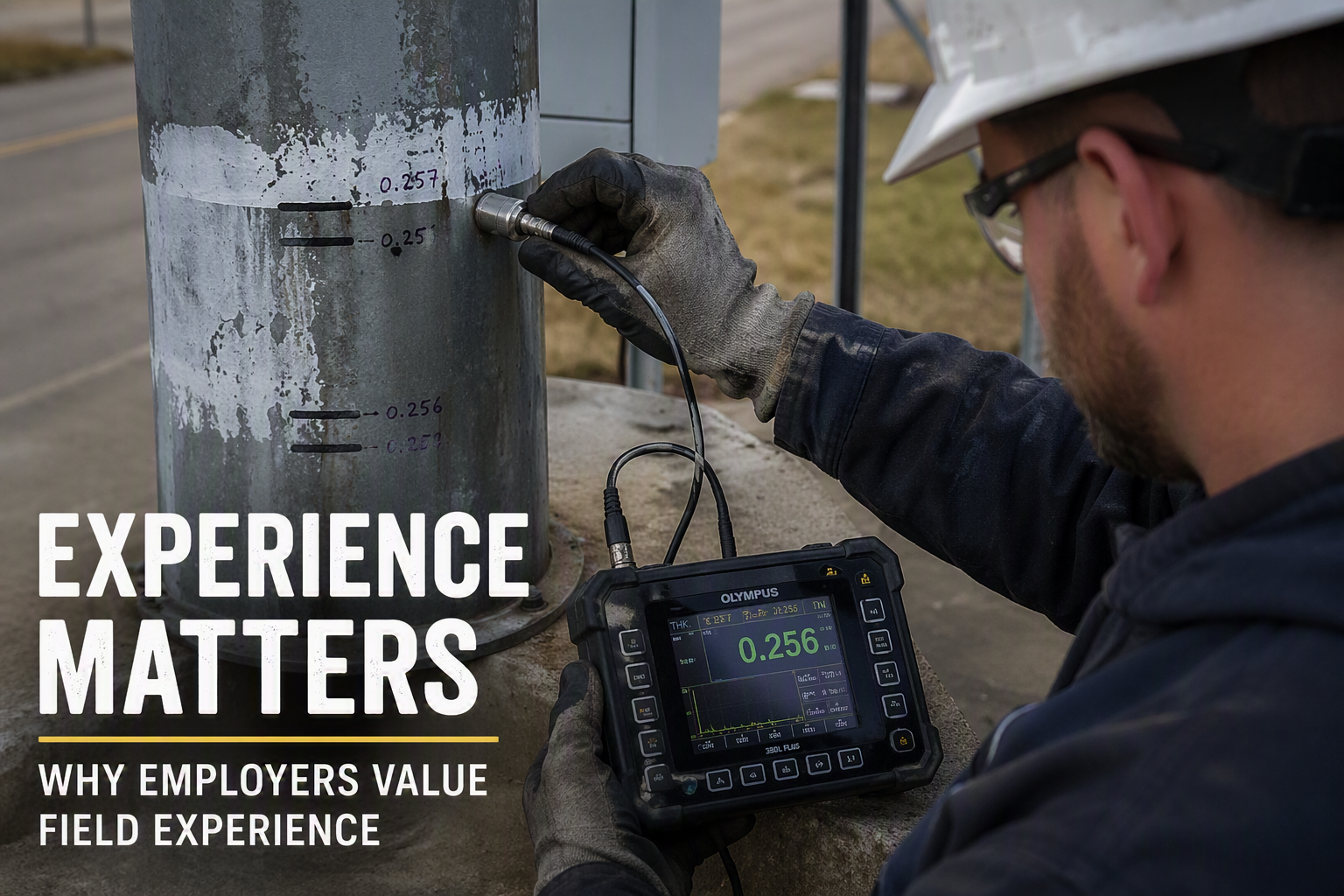
When people first enter the world of nondestructive testing (NDT), they often assume that certifications are the most important factor in getting hired and advancing their careers. While certifications are absolutely important and often required, experienced employers know that a certificate alone does not guarantee competence in the field.
The truth is that the best NDT technicians combine formal training, certification, and real-world experience. In many situations, employers place a higher value on proven field experience than certifications by themselves. Understanding why can help new technicians focus their efforts on becoming more valuable employees and stronger inspectors.
Certifications play a critical role in the NDT industry. They demonstrate that a technician has completed the required training, passed examinations, and met the minimum knowledge requirements for a particular testing method.
Whether pursuing Visual Testing (VT), Magnetic Particle Testing (MT), Liquid Penetrant Testing (PT), Ultrasonic Testing (UT), or another method, certification helps establish a foundation of technical knowledge. Employers need certified personnel to satisfy customer requirements, codes, standards, and internal quality systems.
However, earning a certification is only the beginning of a technician's professional development.
One of the biggest challenges facing new technicians is the gap between classroom knowledge and field performance.
In a training environment, inspectors typically work with carefully prepared samples and controlled conditions. Equipment functions properly, lighting is adequate, and instructors are available to answer questions.
The field is different.
Technicians often encounter:
Successfully navigating these situations requires practical experience that cannot be fully taught in a classroom.
An experienced technician learns how to adapt while maintaining compliance, safety, and inspection quality.
Many newcomers are surprised to discover that no two inspections are exactly alike.
A technician performing ultrasonic thickness measurements on a steel pole may encounter corrosion patterns that differ significantly from those seen on previous inspections. A weld inspection performed in a fabrication shop presents different challenges than one conducted on an elevated structure in the field.
Experienced inspectors develop an instinct for recognizing unusual conditions, identifying potential sources of error, and determining when additional evaluation may be required.
This ability comes from repetition and exposure to real-world situations rather than simply studying procedures.
Confidence is a critical attribute in the NDT profession.
Customers, project managers, engineers, and quality personnel often rely on NDT technicians to make important decisions regarding safety and asset integrity.
An inexperienced technician may understand the theory of a testing method but hesitate when faced with a difficult call. A seasoned technician has likely encountered similar situations before and can approach the task with a higher level of confidence and professionalism.
Confidence should never replace procedure compliance, but practical experience helps inspectors apply their knowledge effectively when conditions become challenging.
Successful NDT technicians do much more than operate equipment.
They solve problems.
For example, an experienced inspector might need to:
Employers value technicians who can work independently and make sound decisions without constant supervision.
These skills are developed through experience rather than certification examinations.
Technical ability alone does not make a great NDT technician.
The ability to communicate findings clearly is equally important.
Inspectors regularly interact with:
Experienced technicians learn how to explain inspection results in a professional and understandable manner. They know how to write effective reports, answer questions confidently, and represent their employers positively in the field.
These communication skills often develop through years of interacting with customers and coworkers.
Most qualification systems recognize the importance of experience.
This is why certification programs generally require on-the-job training (OJT) hours in addition to classroom instruction and examinations.
The industry understands that hands-on exposure is necessary for technicians to become proficient.
Classroom training teaches theory.
Testing measures knowledge.
Experience develops judgment.
All three are essential, but judgment is often what separates an average technician from an exceptional one.
If you're new to the industry, don't be discouraged by the emphasis on experience.
Every expert inspector started as a beginner.
To accelerate your development:
The more exposure you gain, the more valuable you become to employers.
Not all training programs are created equal.
The most effective NDT courses combine classroom instruction with practical application. Students should have opportunities to work with actual equipment, inspect realistic samples, and apply the concepts they learn.
Hands-on experience helps bridge the gap between certification requirements and real-world performance.
When evaluating an NDT training provider, look for programs that emphasize both technical knowledge and practical skill development.
Certifications are important. They demonstrate knowledge, satisfy industry requirements, and help technicians begin their careers. However, most employers understand that certifications alone do not tell the full story.
Experience teaches technicians how to apply their knowledge, communicate effectively, solve problems, and make sound decisions under real-world conditions.
The most successful NDT professionals combine strong training, valid certifications, and years of practical experience. For employers seeking reliable inspectors, that combination is often far more valuable than a certificate alone.
At TXNDT, we believe the best way to prepare future inspectors is through a combination of classroom learning, hands-on training, and real-world industry knowledge. Building experience takes time, but it is one of the most important investments an NDT technician can make in their future.