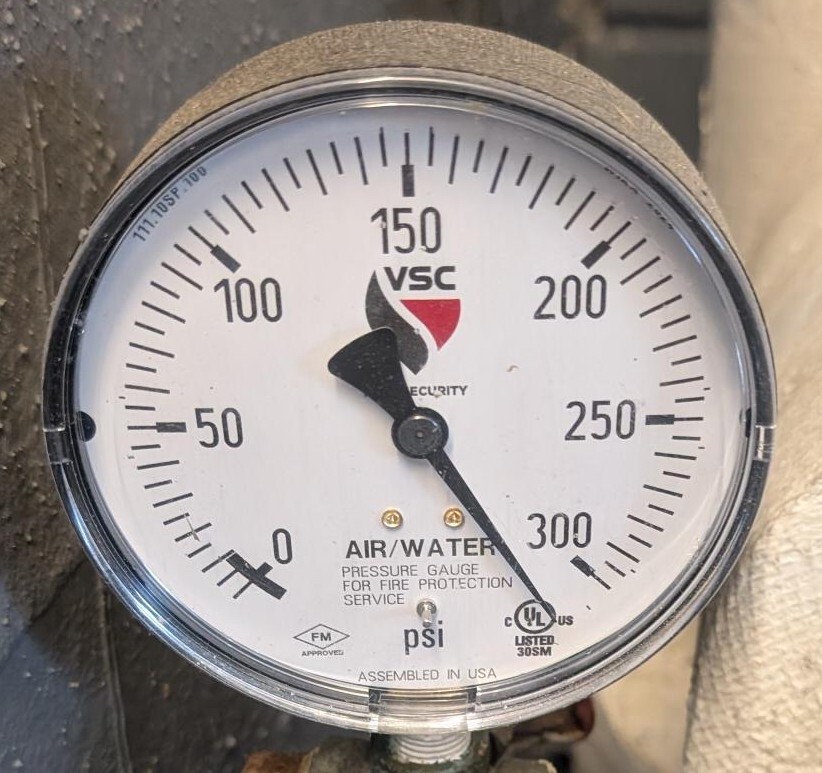
Hundreds of people walk past this pressure gauge every day.
Most never notice it.
Some glance at it and assume everything must be fine.
Others notice the needle appears to be at the end of the scale and immediately assume there is a problem.
The truth is that neither conclusion is necessarily correct.
As inspectors, we are trained to ask a different question:
What do the acceptance criteria say?
That question may sound simple, but it sits at the core of professional inspection and quality assurance.
Looking at the gauge, we can make a few observations.
Those observations are facts.
What we do not know from the photograph alone is equally important.
Without the governing requirements, we simply don't know.
And that's an important lesson.
An observation alone does not make something acceptable or rejectable.
Many people can look at an object and form an opinion.
Inspectors are expected to do more than that.
Professional inspection is not about opinions.
It is not about what seems right.
It is not about what we hope the answer will be.
It is about comparing observable conditions against established requirements.
Those requirements may come from:
If the governing acceptance criteria says the condition is acceptable, then it is acceptable.
If the governing acceptance criteria says the condition is rejectable, then it is rejectable.
Our job is to accurately determine which side of that line the condition falls on.
This same principle is taught throughout our NDT Training programs and reinforced through practical application in both the classroom and the field.
If you stay in this industry long enough, there is a very good chance you will eventually be asked to accept something that does not meet the requirements.
Sometimes the request is direct.
Sometimes it is subtle.
The reasons can vary:
Requests often sound harmless.
"Can you inspect it again?"
"Maybe use a different setup."
"Can you perform the inspection a different way?"
"Do we really need to inspect that area?"
The problem is that none of those requests change the acceptance criteria.
If a procedure requires examination from multiple directions, inspecting from only one direction does not satisfy the procedure.
If a procedure requires a specific magnetic field orientation, reducing coverage does not change the requirement.
If an indication exceeds the acceptance limits, repeating the examination does not automatically make it acceptable.
The requirements remain the requirements.
One comparison I often make is that inspectors are similar to police officers enforcing a law.
Inspectors do not write the code.
Inspectors do not create the acceptance criteria.
Inspectors do not decide what is acceptable.
Inspectors simply apply the requirements they have been given.
If someone believes the requirements should change, that conversation belongs with the engineer, customer, owner, or another authority capable of making that decision.
The inspector's role is different.
Our responsibility is to report what we find within the limits of the governing requirements.
Nothing more.
Nothing less.
This is also why organizations frequently seek outside technical guidance and Level III consulting services when questions arise regarding code interpretation, certification requirements, inspection procedures, acceptance criteria, training programs, and qualification systems.
Have an inspection procedure, acceptance criterion, or qualification question for your company? Send a Level III consulting inquiry.
Acceptance criteria eliminate guesswork.
They provide consistency.
They allow different inspectors, working at different locations, to evaluate conditions against the same standard.
Without acceptance criteria, every inspection becomes an opinion.
With acceptance criteria, inspections become repeatable, defensible, and objective.
That consistency is one of the reasons codes, standards, specifications, and procedures are so important throughout the NDT industry.
Whether performing Ultrasonic Testing, Magnetic Particle Testing, Liquid Penetrant Testing, Visual Testing, or any other examination method, the inspector must ultimately compare the observed condition against established acceptance criteria.
Learning how to properly evaluate conditions, understand acceptance criteria, and apply inspection requirements is one of the most important skills covered throughout the courses found in our Course Catalog.
Maybe.
Maybe not.
The photograph alone doesn't provide enough information to make that determination.
And that is exactly the point.
Good inspectors understand the difference between an observation and a conclusion.
Before making a decision, they seek the criteria.
They verify the requirements.
They compare the facts against the acceptance standards.
Only then do they make a determination.
Whether we are inspecting a pressure system, a weld, a casting, a utility pole, critical infrastructure, or any other component, the process remains the same.
Observe.
Verify.
Compare against the acceptance criteria.
Report the results.
Because at the end of the day, professional inspection is not about guessing.
Good inspectors don't guess. They verify.
The hardest part of inspection is rarely finding the indication.