There is a place for books in NDT training.
There is also a place where the book ends and the learning really begins.
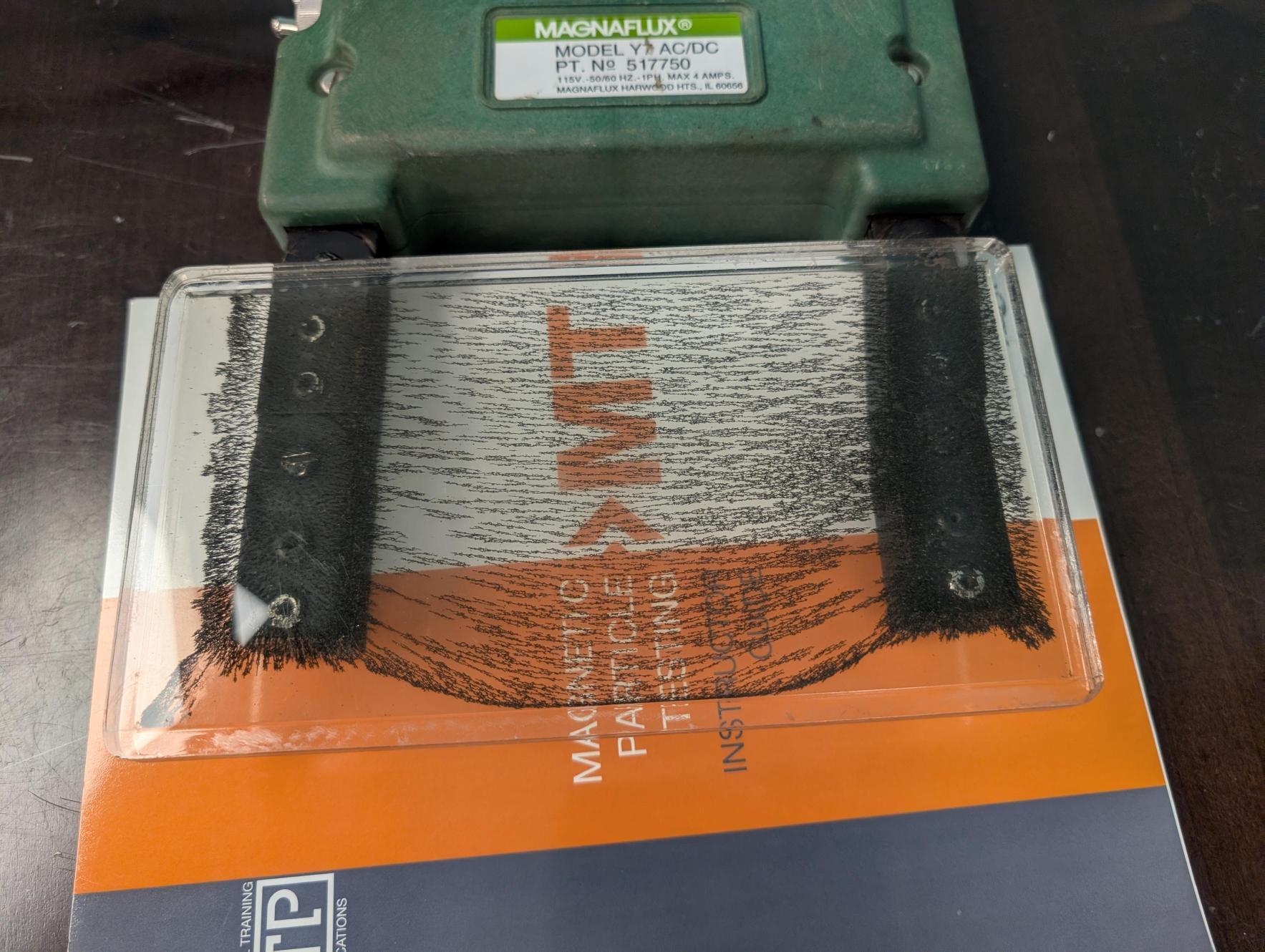
The photo here is a perfect example.
An ASNT Magnetic Particle Testing training book is being used as the backdrop. Sitting on top of it is a magnetic particle demonstration showing the actual magnetic field patterns created by a yoke. The book provides the theory. The demonstration provides the understanding.
Most training programs do a good job teaching what to do.
Fewer spend enough time teaching why it works.
When students first learn Magnetic Particle Testing, they read about magnetic flux, leakage fields, and particle accumulation. Those concepts are critical. The industry needs technicians who understand the science behind the method, not just the steps.
But something changes when a student can physically see the magnetic field.
The black magnetic particles in this demonstration align themselves along the magnetic flux lines created by the yoke. The pattern isn't drawn. It isn't simulated. It is the actual magnetic field made visible.
Suddenly, terms like "flux flow" and "field direction" stop being abstract concepts in a textbook.
They become real.
That is where hands-on training becomes invaluable.
A book can explain why a crack parallel to the magnetic field may not produce an indication. A lecture can describe the relationship between discontinuity orientation and detectability. But when a student watches the magnetic field form in real time and sees how those particles respond, the lesson tends to stick.
That understanding carries forward into every magnetic particle inspection they perform.
At TXNDT, we believe the classroom provides the foundation, but practical exercises are where confidence is built.
A student who only memorizes procedures may know what button to push or what step comes next. A student who understands the underlying principles can troubleshoot a difficult inspection, recognize when something doesn't look right, and make informed decisions in the field.
The goal is not simply to create technicians who can follow a procedure.
The goal is to develop inspectors who understand the method.
That's why demonstrations, practical labs, real-world examples, and discussions are such an important part of our courses. The textbook explains the concepts. The hands-on exercises bring those concepts to life.
In many ways, this photograph captures exactly what good NDT training should be.
The book is still there.
It remains an essential resource and an excellent foundation.
But the most valuable lesson may be the magnetic field sitting on top of it.
Sometimes the fastest way to understand a concept is to see it happen right in front of you.