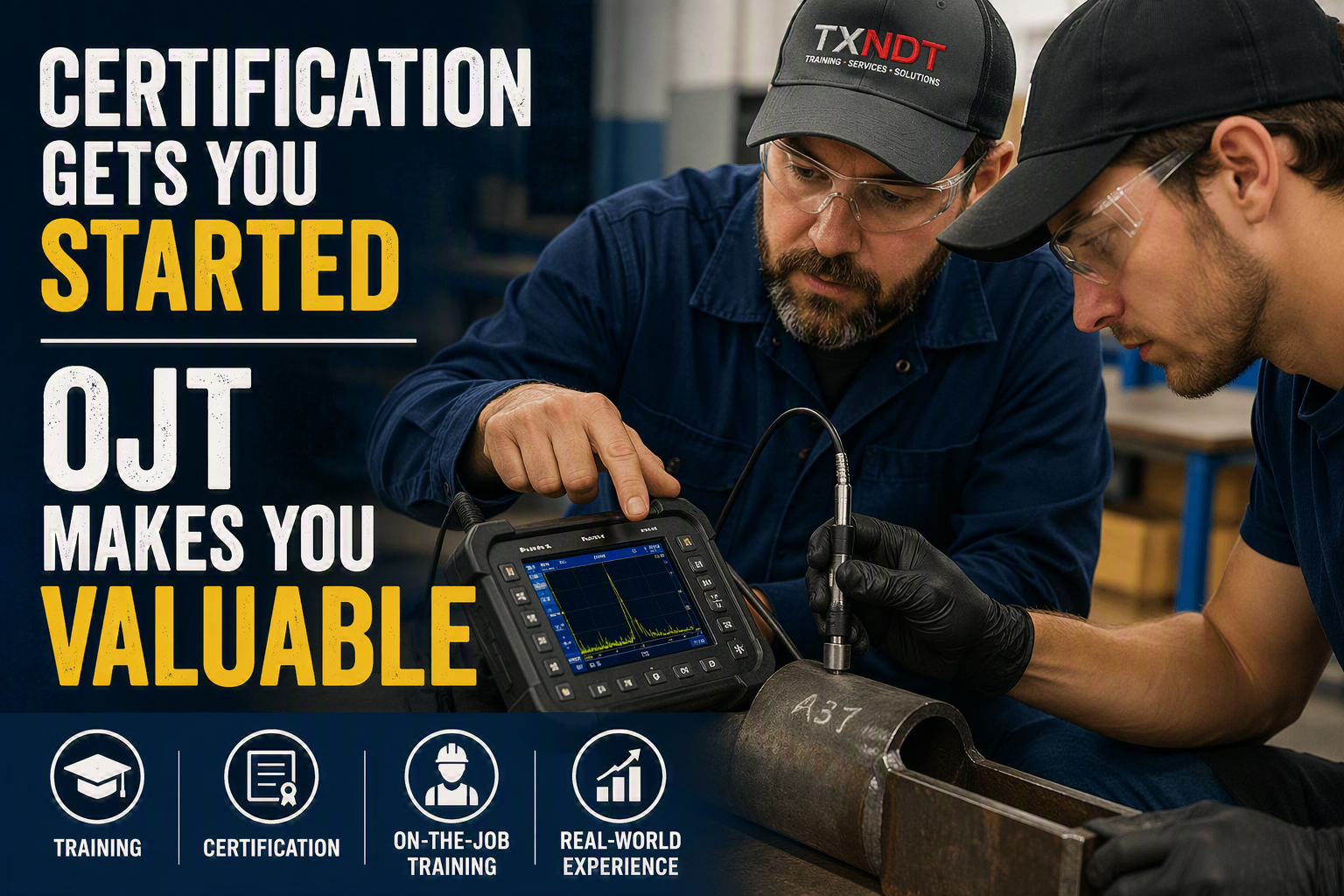
One of the most common questions asked by new NDT students is:
"Once I complete my class, am I certified?"
The answer is usually more complicated than many people expect.
In the world of nondestructive testing (NDT), classroom training is only one piece of the puzzle. While training is essential, employers are ultimately looking for technicians who can successfully apply their knowledge in the real world. This is where On-the-Job Training (OJT) becomes one of the most important parts of professional development.
Understanding the relationship between classroom training, certification, and OJT can help future inspectors build realistic expectations and stronger careers.
On-the-Job Training, commonly referred to as OJT, is the hands-on experience a technician gains while performing inspections under qualified supervision.
Unlike a classroom environment where students learn theory and fundamentals, OJT places technicians in actual work situations where they begin applying what they have learned.
This experience may involve:
OJT helps bridge the gap between education and competence.
A classroom can teach how ultrasonic sound travels through a material.
A classroom can teach the principles of magnetic particle testing.
A classroom can explain why indications appear during penetrant testing.
What a classroom cannot fully replicate is the unpredictable nature of field inspections.
Every job site presents unique challenges.
Lighting conditions change.
Surface conditions vary.
Equipment occasionally misbehaves.
Customers have questions.
Schedules become compressed.
Weather rarely cooperates.
OJT exposes technicians to these realities while allowing them to develop practical skills under supervision.
Many NDT procedures are straightforward when viewed in a textbook.
Real-world inspections are not always so simple.
Experienced technicians learn how to:
These skills come from repetition and exposure to real inspections.
Over time, OJT develops professional judgment that is difficult to gain in any other way.
Most employers understand that successful inspectors require more than classroom hours.
They need professionals who can safely and effectively work in real environments.
A technician with documented OJT demonstrates:
This is one reason why many certification systems require both formal training and documented experience before certification can be achieved.
While hours are important, quality experience is equally valuable.
A technician who spends time working alongside experienced inspectors often learns more than someone accumulating hours without guidance.
The best OJT environments provide opportunities to:
Strong mentorship can significantly accelerate professional growth.
For new technicians, the goal should not simply be accumulating enough hours to satisfy a requirement.
The objective should be becoming a valuable member of an inspection team.
Technicians who actively learn during OJT often gain proficiency faster and become candidates for advanced responsibilities sooner.
Some ways to maximize OJT include:
The more experience a technician gains, the more opportunities become available.
Every experienced NDT professional began as a trainee.
No Level III started their career with decades of experience.
The difference between average and exceptional technicians is often a commitment to continuous learning and practical development.
Classroom training provides the foundation.
Certification demonstrates knowledge.
OJT develops competence.
Together, they create skilled inspectors capable of protecting critical infrastructure, maintaining quality, and advancing the NDT profession.
A training certificate can open the door to a career in NDT, but professional growth happens through experience.
The most successful technicians understand that learning doesn't stop when class ends. In many ways, that's where the real education begins.
At TXNDT, we encourage students to view training as the first step in a lifelong learning process. Developing practical skills through quality OJT is one of the most effective ways to build a rewarding and successful career in nondestructive testing.